There are probably very few Pakistanis who need this sentence explained:
“Log kya kahenge?”
You want to change your career.
Log kya kahenge?
You are approaching 30 and are still unmarried.
Log kya kahenge?
You want to leave a marriage that everyone else thinks looks perfectly fine.
Log kya kahenge?
You want to move out. Go to therapy. Say no to a relative. Wear something your family would not approve of. Marry someone of your choice. Not marry at all. Leave a respectable job and start again.
And somehow, before you have even made the decision, log have already entered the conversation.
I have always found that interesting.
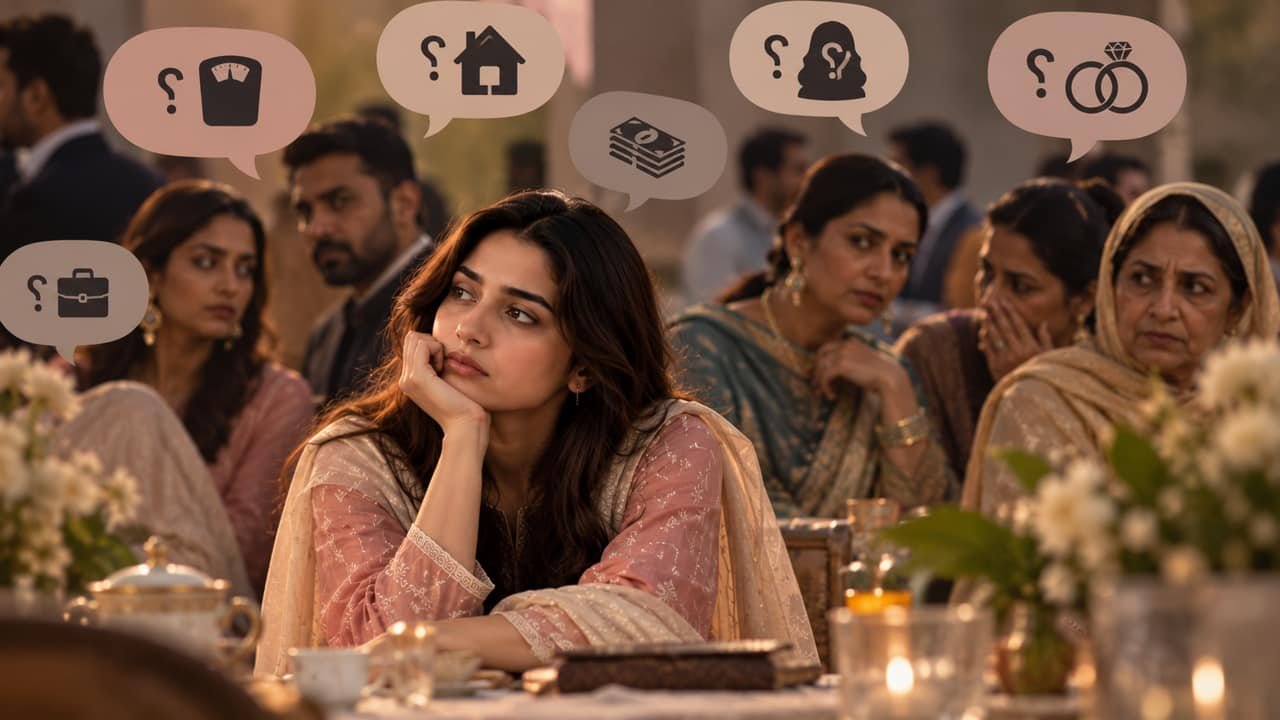
Because who exactly are these log?
Your parents? Your phuppo? Three cousins? The neighbours? Someone who meets you twice a year at weddings?
And did they actually say anything?
Or have we already imagined what they are going to say?
That distinction matters more than we realise.
Let’s be fair: sometimes the judgement is very real
I don’t want to turn this into the usual advice of “Logon ko ignore karo, apni zindagi jiyo.”
That sounds nice. Real life is more complicated.
In Pakistan, our lives are often deeply connected to our families. Decisions about education, work, marriage, money and where we live rarely exist in complete isolation.
Research on Pakistani young adults reflects this. Education, employment, marriage, financial dependence, gender expectations and family relationships can all shape how adulthood is negotiated. Women may face expectations around marriage and domestic roles, while men can carry equally rigid expectations around earning, providing and becoming financially established. Research on young adulthood in Pakistan
So when someone tells me:
“Main apni marzi kar bhi loon, ghar walon ko jawab dena parta hai.”
I understand what they mean.
There can be actual consequences.
A woman considering divorce may know perfectly well how differently some relatives will treat her afterwards.
Someone may avoid psychological help because they fear what will happen if relatives find out.
A man struggling financially may hide it because he knows exactly what is expected of him.
A girl considering moving away for work may not simply be imagining the objections waiting for her at home.
This is why reducing the whole thing to “stop caring what people think” doesn’t really help.
But that is only one part of log kya kahenge.
The other part is happening inside our own heads.
When “log kya kahenge?” starts influencing a decision, ask yourself:
1. Who exactly am I afraid of?
2. Have they actually said anything, or am I anticipating their judgement?
3. Do I believe that judgement myself?
What if nobody has actually said anything yet?

A woman gets a great job opportunity in another city.
Before she has even discussed it properly with her family:
“Akeli doosre shehar chali gayi tou relatives kya kahenge?”
Someone wants to end an engagement.
“Sab kahenge is mein hi koi masla hoga.”
A man in his thirties has a respectable job that makes him miserable. He thinks about changing careers.
“Log kahenge itni achi job chhor di? Dimagh kharab hai?”
Pause there.
Who said that?
Maybe somebody has said similar things before. Maybe his family really would react like that.
But maybe nobody has said anything about this decision yet.
His mind has completed the conversation for them. It’s a familiar pattern: our minds can keep returning to interactions and filling in what others might think. I explore a related pattern in Why Your Mind Replays Awkward Moments.
That is where this becomes psychologically interesting.
A 2025 study specifically examining log kya kahenge among Pakistani young adults found people describing changes in dress, language and career choices in response to perceived social expectations. Around 40% of participants were described as adapting their behaviour to societal expectations, while 30% associated social criticism with experiences such as anxiety, shame and self-doubt. Read the study in Discover Psychology
The word I find especially important here is perceived.
We don’t respond only to what people actually think about us.
We respond to what we think they think about us.
Those two things can overlap.
They are not always the same.
How social pressure becomes internalised
Grow up in any social environment long enough and you learn its unwritten rules.
Nobody has to sit you down with a notebook.
You know.
You know which careers make relatives respond with “MashAllah” and which require a five-minute explanation.
You know when an unmarried woman’s age starts becoming part of introductions.
You know what a “good daughter” is supposed to look like.
You know how differently “apni baat rakhna” can be interpreted depending on whether a son or daughter is doing it.
You know what a successful man is expected to earn.
You know how divorce is discussed.
You know which clothes will attract comments.
You know what happens when someone does something that “hamare khandaan mein nahi hota.”
After a while, people don’t have to police every decision.
We become quite capable of doing it ourselves.
“Yeh theek nahi lagega.”
“Log ajeeb samjhenge.”
“Mere ghar mein yeh nahi hota.”
“Iss age mein ab yeh karungi?”
“Sab kya sochenge?”
The audience has moved inside.
Nobody needs to be sitting in the room anymore.
And then there is a slightly uncomfortable possibility
This is the part I think we talk about much less.
Maybe some of our fear of judgement comes from knowing how easily we judge other people too.
Suppose for years I have looked at unmarried women and thought:
“30 ki ho gayi, abhi tak shaadi nahi hui?”
Then I turn 30.
Still unmarried.
I don’t need anybody to explain what people might think. I already know the script because I have used it myself.
Maybe I once heard about someone’s divorce and said:
“Itni achi shaadi thi. Pata nahi divorce kyun le liya.”
Years later, my own marriage is falling apart.
Now I know exactly what I am afraid people will say.
Or I looked at someone changing careers and thought:
“Itni parhai karke yeh kaam kar rahi hai?”
Then one day I realise I hate the career I chose.
Suddenly, changing direction feels much more embarrassing.
We comment on people’s bodies, salaries, houses, marriages, children, clothes, careers and timelines so casually that we barely notice we’re doing it.
Then our own life changes.
And we remember how people talk.
Because sometimes we were the people talking.
I wouldn’t call every fear of judgement, projection. That would be too convenient and, frankly, inaccurate. Families can be judgemental. Communities can punish people socially. Gossip can damage relationships. Some consequences are very real.
But our own way of looking at other people can teach us what judgement sounds like.
Later, we may expect the same judgement to come back to us.
Which makes me wonder whether getting free from log kya kahenge is only about becoming less afraid of judgement.
Maybe part of it is becoming less judgemental ourselves.
Caring what people think is not a psychological defect
We sometimes talk about this as though a mentally strong person simply wouldn’t care.
That isn’t how human beings work.
We are social.
We want to belong. We want acceptance. Rejection hurts. Relationships matter to us.
There is nothing automatically unhealthy about taking other people’s opinions seriously.
In fact, imagine the opposite: a society where nobody cared how their behaviour affected anyone else.
That wouldn’t exactly be psychological freedom either.
Social expectations can encourage responsibility, cooperation and consideration. Families can give good advice. Communities can provide belonging and protection. People who love us can sometimes see something we’re too emotionally involved to see ourselves.
Even research on log kya kahenge does not suggest that every form of social influence produces the same response. People’s experiences vary.
So perhaps:
“Why do I care what people think?”
isn’t the most useful question.
I would ask:
“How much authority am I giving their opinion over my decision?”
That changes the conversation.
In Pakistan, a decision is rarely just “my decision”
This is also where some popular psychology advice doesn’t translate very well into Pakistani life.
Your life.
Your choice.
Your boundaries.
Do what makes you happy.
Fine.
But what if your career contributes to your family’s finances?
What if moving to another city means leaving ageing parents?
What if marriage connects not only two people but two families who are now deeply involved in one another’s lives?
What if an adult child is still financially dependent on their parents?
What if refusing something carries consequences beyond an uncomfortable conversation?
Pakistani research on the transition to adulthood shows exactly this complexity. Family relationships, economic dependence, gender, social class and place can all affect how much freedom a young adult practically has. See the Pakistan life-course study
So I don’t think the answer is to pretend we are all completely independent individuals.
We’re not.
And many people don’t want to be.
There is something valuable about interdependence. About family. About knowing that your decisions affect people you love.
The problem begins when being connected to people slowly becomes giving them ownership of your life.
You can value your parents’ opinion without automatically turning it into your opinion.
You can consider how your choice affects your family without believing that every relative deserves a vote.
You can love your community and still disagree with something it expects from you.
That balance is much harder than saying “I don’t care what anyone thinks.”
It is also much more realistic.
“Hamare khandaan mein aisa nahi hota”

I find this sentence fascinating because it can mean so many different things.
Sometimes it represents a genuine value.
Sometimes it represents a rule nobody remembers choosing.
“Hamare ghar ki larkiyan bahar nahi rehtin.”
“Hamare khandaan mein divorce nahi hoti.”
“Larkay rote huay achay nahi lagtay.”
“Itni umar mein career change nahi kartay.”
“Psychologist ke paas jaane ki kya zarurat hai?”
Say something often enough, and eventually it stops sounding like an opinion.
It starts sounding like reality.
And when a person goes against it, they may not simply feel that they have made a different decision.
They can feel as though they have betrayed their family.
That explains something I see people struggle with quite often: guilt after making a decision they still believe was right.
We tend to treat guilt as evidence.
“Agar mujhe itna bura lag raha hai, shayad main ghalat kar rahi hoon.”
Not necessarily.
Sometimes guilt tells you that you’ve violated a value you genuinely hold.
Other times, it tells you that you’ve stepped outside a rule you were taught to follow.
Those are worth separating.
Most lives aren’t controlled by one dramatic “log kya kahenge” moment
Usually it’s much quieter.
You don’t apply.
You don’t say no.
You don’t wear it.
You don’t leave.
You don’t start.
You don’t ask for help.
You don’t tell anyone what happened.
You accept the rishta.
You stay in the degree.
You keep the job.
You laugh at the joke.
You hide the diagnosis.
You postpone the conversation.
“Chalo, rehne do.”
Nothing dramatic happened.
And that’s exactly why this can be difficult to notice.
One small decision doesn’t look like much.
But lives are built out of small decisions.
Years later, somebody can have a life that looks completely respectable from the outside and still wonder:
When did I actually choose this?
That, for me, is where log kya kahenge becomes expensive.
Not because somebody talked.
Because fear of them talking quietly started making decisions for us.
So whose opinion actually deserves space?
I don’t think we need to become people who don’t listen to anyone.
We need to become better at deciding who gets a voice and who gets a vote.
Next time “log kya kahenge?” appears in your head, make the log specific.
Who?
Your parents?
Your closest friend?
Your phuppo?
Neighbours?
Colleagues?
People on Instagram?
A relative who sees you at two weddings a year?
Don’t leave them as a mysterious crowd.
Name them.
Then ask yourself what you think they’re going to say.
Not:
“They’ll judge me.”
That’s too vague.
What will they think?
“They’ll think I’m selfish.”
“They’ll think my marriage failed.”
“They’ll think I’m unsuccessful.”
“They’ll think I’m too old.”
“They’ll think I’m a bad daughter.”
Good.
Now at least we know what we’re afraid of.
Then ask:
Have they actually said this?
If they have, your fear has some evidence behind it.
If they haven’t, there may be an imagined conversation mixed in with the real one.
And then I would ask the question that may be hardest of all:
Do I believe it too?
If being unmarried at 30 terrifies me partly because I believe a woman should be married by 30, then ignoring my relatives won’t solve the whole problem.
There is a belief inside me that needs examining.
If changing careers feels humiliating because I secretly see starting again as failure, that is mine to look at.
And if I hate people commenting on my weight, marriage, income and choices while casually doing the same thing to others…
Well.
Maybe there is work to do on both sides.
Because we are all somebody else’s “log”
We usually tell this story from the position of the person being judged.
But think about it from the other side.
In somebody else’s story, you are one of the log.
You are the cousin hearing that a marriage ended.
The friend watching someone change careers.
The relative asking why somebody isn’t married yet.
The colleague noticing someone’s weight.
The person discussing another woman’s clothes after she leaves.
The family member asking a couple when they’re going to have children.
If we want to live in a culture where people are less terrified of judgement, learning to tolerate judgement ourselves is only half of it.
We also need to give other people fewer reasons to be frightened of ours.
Ask fewer questions that aren’t ours to ask.
Stop treating another person’s difficult decision as family entertainment.
Allow ourselves to say:
“Mujhe nahi pata usne yeh decision kyun liya. Ho sakta hai mujhe poori kahani hi na pata ho.”
Sometimes that’s enough.
We don’t have to understand every decision to leave somebody’s dignity intact.
Marriage doesn’t automatically prove maturity.
Divorce doesn’t automatically prove failure.
Money doesn’t automatically prove success.
Silence doesn’t always mean respect.
Obedience isn’t the same thing as good character.
And a life that looks strange from the outside may make perfect sense once you know what happened inside it.
Maybe the goal was never to stop caring
I don’t want to stop caring what the people I love think.
I don’t think most of us do.
Sometimes our families are right.
Sometimes they know us well enough to notice what we’re missing.
Sometimes compromise is love, not weakness.
Sometimes another person’s needs genuinely should influence our decision.
But there will also be decisions where we find ourselves asking permission from people who will never have to live with the outcome.
That’s where I would change the question.
Instead of:
“Log kya kahenge?”
maybe ask:
“Jab log keh kar chup ho jayenge, is decision ke saath rehna kis ne hai?”
Because eventually they do become quiet.
The wedding ends.
The relatives go home.
The WhatsApp conversation moves on.
Someone else becomes interesting.
Some people may approve of you. Some won’t. Some will misunderstand you completely.
And, quite often, people will care much less than you imagined they would.
But you’re still there.
With the marriage.
The career.
The degree.
The body.
The relationship.
The decision you made.
The life you have to wake up to the next morning.
So perhaps freedom from log kya kahenge isn’t becoming someone who doesn’t care about people.
It is learning where their voice ends and yours begins.
And if we want that freedom for ourselves, we should probably become a little more careful about the freedom we give other people too.
Because somewhere, somebody is worrying about what log will say.
And without realising it,
we may be the log.
Sources & further reading
Effects of public perceptions and social conformity on behaviour and mental wellbeing of young adults in Pakistan — Discover Psychology (2025).
Research on transitions to adulthood and family interdependence in Pakistan — PubMed record.
6 responses