Every few weeks, it seems, another case appears on our screens.
A child goes missing. A body is recovered. A post-mortem reveals sexual assault. Someone known to the family is arrested. A teacher, relative, neighbour, religious instructor or older child comes under investigation. There is outrage for a few days. Social media fills with anger. People demand the harshest possible punishment.
Then another story replaces it.
In August 2026, a five-year-old girl in Haripur who had been missing for two weeks was found dead in an unused well. Her post-mortem confirmed sexual assault; doctors reported excessive bleeding and shock as the cause of death, while forensic samples were handed to police for further investigation. Dawn
It is difficult to read a case like this without asking: What kind of person could do this to a child?
I understand that question. As a clinical psychologist, though, I find myself asking another one alongside it:
How did the child become accessible to harm in the first place?
That question takes us beyond the psychology of an offender. It takes us into families, authority, trust, institutions, reporting systems, policing, courts, media and, eventually, our own psychological response as a society.
Because one person may commit an offence. But protecting a child depends on many more people than one.
The numbers we see are not the whole problem
According to child-protection organisation Sahil’s Cruel Numbers monitoring, 1,914 cases of child abuse were reported in Pakistani newspapers between January and June 2026. These included 1,015 cases of child sexual abuse, 558 abductions, 101 cases of missing children and 35 child marriages. The monitoring drew on national and regional newspapers across Pakistan, including the federal and administered territories.
That number is alarming. But it needs to be understood correctly.
It does not mean exactly 1,914 children were abused in Pakistan during those six months. eDawn Paper
There is a chain between abuse occurring and the rest of us ever knowing about it:
Abuse occurs → the child discloses or someone discovers it → the family or another adult reports it → authorities record it → the case reaches the media.
A child can disappear from that chain at almost every point.
Some children do not understand what happened. Some cannot explain it. Some are threatened. Some fear punishment. Families may fear stigma or social consequences. And some incidents that reach authorities never become newspaper stories.
Recent research on Pakistani media has itself identified under-reporting as a significant problem, with journalists describing unreported cases and cultural barriers as obstacles to comprehensive coverage. A 2026 study also found that taboos surrounding family privacy and cultural attitudes can contribute to under-reporting of some forms of child abuse. UMT Journals
So the responsible conclusion is not, “We know exactly how many children are being abused.”
We don’t.
What we know is how many entered particular reporting systems.
And the children missing from those systems concern me just as much as the children represented by the statistics.
We teach children to fear strangers. But what if the danger is familiar?
One finding in Sahil’s 2026 monitoring deserves particular attention.
In 43% of reported cases, the alleged abuser was an acquaintance. Around 45% of reported incidents occurred in the victim’s home. Pakistan Today
Think about how we traditionally teach safety in Pakistan.
- Stranger se baat nahi karni.
- Stranger ke saath nahi jana.
That advice has value, but it is incomplete.
A child may encounter risk from someone who does not look dangerous at all: a relative, neighbour, teacher, religious instructor, family friend, caregiver or another older child.
This does not mean parents should become suspicious of everyone around their children. Hypervigilance is not safeguarding.
But familiarity is not evidence of safety either.
A better principle is that trust should never eliminate reasonable boundaries.
Who can spend time alone with the child? In what setting? Is anybody supervising? Can the child refuse physical contact even with an elder? Does the family take discomfort seriously, or is the child immediately told, “Aise nahi kehte, woh baray hain”?
These seem like small questions until something happens.
Then suddenly they become enormous.
We underestimate the psychology of power
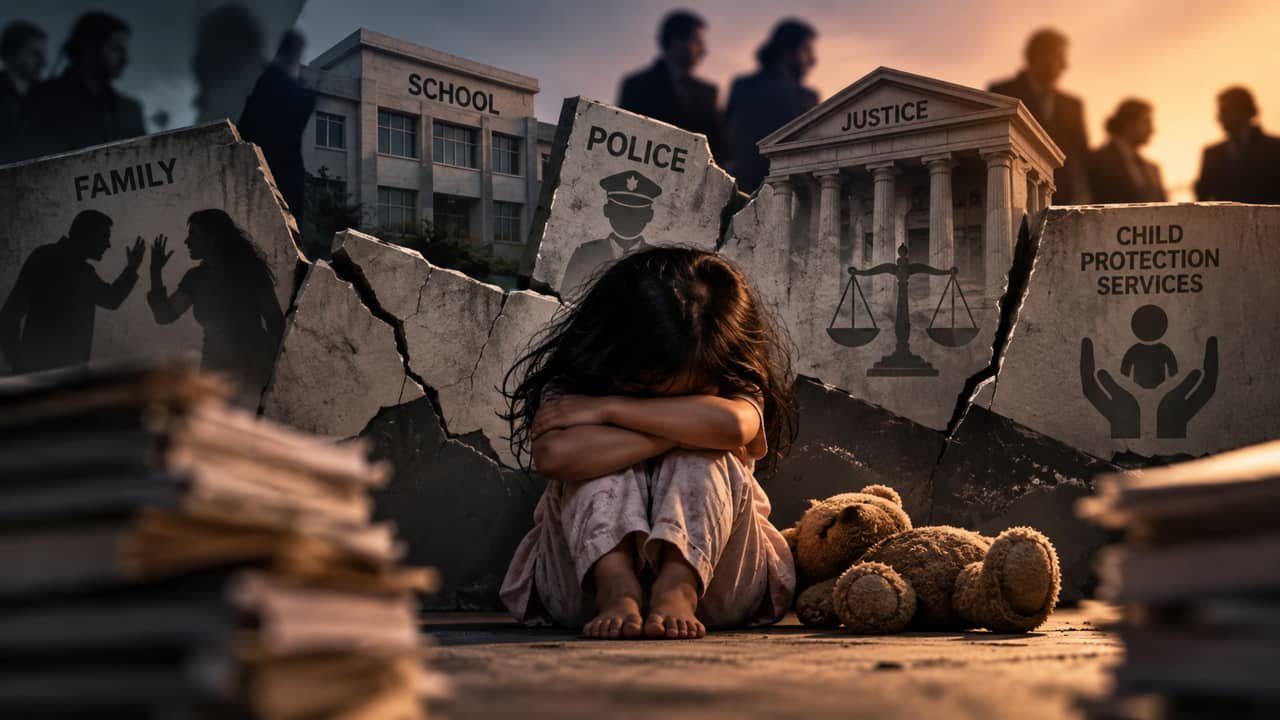
Adults often look at children’s behaviour through an adult mind.
- “Why didn’t the child run?”
- “Why did they go there again?”
- “Why didn’t they scream?”
- “Why didn’t they tell their mother?”
But a child and an adult-or a child and an older person in authority-do not enter a situation with equal psychological power.
The adult may control approval, punishment, transport, education, affection or access to things the child needs. A teacher carries authority. So does a caregiver. So can an older relative.
Then there are the messages many Pakistani children hear from an early age:
- Baron ki baat maano.
- Teacher ki respect karo.
- Bad-tameezi mat karo.
Under threat, human beings do not always fight or escape. Freezing, becoming quiet or complying can also occur. A child’s apparent compliance therefore cannot automatically be interpreted as willingness.
Respect itself is not the problem. Obedience without boundaries can be.
This is also why grooming matters.
Grooming can involve gradually gaining trust, increasing access, testing boundaries, creating secrecy and establishing control. Sometimes the person does not only build credibility with the child. They build it with the adults around the child.
That is precisely what makes some situations difficult to recognise.
“Why didn’t the child tell?”
This may be one of the most damaging questions when asked carelessly.
A child may lack the vocabulary to describe sexual behaviour. They may not understand that a boundary has been crossed. They may have been threatened or manipulated. They may fear losing someone they depend on.
And shame changes disclosure further.
Imagine a child trying to communicate something frightening and immediately hearing:
- Tum wahan gaye hi kyun thay?
- Pehle kyun nahi bataya?
- Are you sure?
- Uncle aisa nahi kar sakte.
What has the child just learned?
Not necessarily that the abuse was acceptable.
They may have learned that speaking about it is dangerous too.
As a psychologist, I think we need to change the question.
Instead of only asking “Why didn’t the child tell?”, adults should also ask:
“Had we created a relationship in which this child believed they could tell us?”
That distinction matters.
A child cannot safeguard themselves out of an unsafe system

Teaching children body safety is important. But there is something uncomfortable about placing too much responsibility on children themselves.
We cannot give a six-year-old a lesson about “good touch and bad touch” and then consider our job finished.
Adults build the environment.
At home, that means children need age-appropriate language for body boundaries, permission to say no to unwanted contact, trusted adults they can approach, and caregivers who can listen before interrogating.
Institutions carry an even greater responsibility.
Any school, madrassa, academy, hostel, sports facility, welfare organisation or other setting that regularly gives adults access to children should be asking basic safeguarding questions.
- Can one adult repeatedly be completely alone with a child?
- How are complaints made?
- Who receives them?
- What happens after a complaint?
- Are staff trained to recognise concerning behaviour?
- Are complaints documented?
- Can a junior employee question a senior person without fearing retaliation?
And perhaps the most uncomfortable question:
If a complaint threatens the institution’s reputation, which one gets protected first-the institution or the child?
A safeguarding policy sitting in a file means very little if people are afraid to use it.
Reporting the crime is only the beginning
Suppose a child does disclose.
Now another journey starts: police reporting, medical examination, forensic evidence, investigation, prosecution and court proceedings.
Pakistan has legal mechanisms specifically intended to address sexual offences. The Anti-Rape (Investigation and Trial) Act 2021 provides for special courts and other mechanisms, and states that covered cases should be decided expeditiously, preferably within four months. A 2026 Peshawar High Court judgment also emphasised child-sensitive procedures, privacy and dignity for minors in sexual-offence trials. Statutes of Pakistan
Yet law on paper and experience in practice are not automatically the same thing.
The National Commission on the Rights of Child’s State of Children in Pakistan 2025 associates low conviction outcomes with weaknesses in investigation, prosecution, evidence collection and case management, alongside delays in trials.
Its Punjab data recorded 33,449 FIRs concerning child-rights violations and child sexual abuse in 2025 and 4,727 convictions, approximately 14%. Importantly, NCRC notes that comparable conviction data were not available from other provinces, so this cannot responsibly be presented as a national CSA conviction rate. National Child Rights Commission
Numbers like these need care.
- An arrest is not a conviction.
- An accusation is not proof.
- A pending case does not mean an offender has escaped justice.
- An acquittal does not automatically tell us why a case failed.
But the system should be capable of collecting evidence properly, protecting witnesses, completing forensic work, preparing prosecution cases and reaching reliable decisions without unnecessary delay.
Justice is not merely registering an FIR.
It is reaching a legally sound outcome through a process that protects both evidence and people.
Why punishment cannot be our only conversation
Whenever an especially brutal case appears, Pakistan’s conversation quickly turns towards punishment.
The anger is understandable.
But punishment comes after a child has already been harmed.
Safeguarding asks what could have happened before.
- Could access have been restricted?
- Could supervision have been better?
- Could an earlier complaint have been taken seriously?
- Could a child have had a safer route to disclosure?
- Could an institution have noticed a pattern?
- Could evidence from an earlier incident have triggered intervention?
A strong child-protection system needs accountability after an offence. But its greatest success would be stopping abuse before another child becomes a complainant, patient, case number or headline.
Are we becoming desensitised?
This is the part of the conversation I think we urgently need to have.
Another case appears.
We are horrified.
We share it.
We demand justice.
A few days later, something else trends.
Then another abused child appears in the news.
Eventually someone says:
“Yahan tou yeh hota rehta hai.”
That sentence frightens me.
Repeated exposure to disturbing material can change how we emotionally respond to it. But we should be careful about claiming that Pakistan has a measured national “desensitisation rate”-I have not found evidence supporting such a number.
What we can examine is the environment that may encourage emotional numbing.
Pakistani media research gives us reason to think critically about how these cases are presented. A 2025 analysis of three major Pakistani television news channels found sensational, dramatic and emotional presentation alongside distressing visuals in CSA coverage. Other Pakistani research has identified problems including sensationalism and lack of sensitivity while also recognising media’s important role in creating awareness. Pakistan Social Sciences Review
That creates a strange contradiction.
Child abuse can be under-reported as a social problem while individual cases are simultaneously over-sensationalised as media events.
Those are not opposites.
One child becomes a national story. Hundreds of experiences remain invisible.
And when the visible cases are repeatedly packaged primarily as horror, audiences may receive plenty of emotional stimulation without learning much about prevention.
We know the gruesome detail.
But do we know what safeguarding procedure was absent?
We know what was found at the crime scene.
But do we know whether an earlier complaint existed?
We know how angry everyone became.
But six months later, do we know what changed?
Media attention can expose abuse and force institutions to respond. That matters enormously. The answer is not silence.
The answer is better attention.
Less voyeurism. More context.
Less identification of children. More scrutiny of systems.
Less obsession with horror. More discussion of prevention.
So who failed them?

There will rarely be one universal answer.
Sometimes an offender deliberately exploits trust despite reasonable safeguards.
Sometimes warning signs were visible.
Sometimes a family did everything it reasonably could.
Sometimes an institution failed.
Sometimes evidence was lost later.
And sometimes we simply do not know enough to make the confident judgments social media demands within hours.
That is why I want Off the Couch to approach these cases differently.
Before asking only “What is wrong with the person who did this?”, I want us to examine the whole chain:
Who had access? Where was the power? What protection existed? Could the child speak safely? Who was supposed to notice? What happened when somebody did? And what changed afterwards?
For parents, start with conversation rather than fear. Teach body autonomy without terrifying children. Make it clear that secrets involving touch, threats or discomfort can always be brought to you. And when a child says something concerning, listen before you question their behaviour.
For institutions, safeguarding cannot remain a poster or policy document. Access, supervision, complaint procedures, staff training, documentation and accountability have to work in practice.
And for the rest of us, perhaps we need to reconsider what we reward with our attention.
A child’s suffering should not have to become graphic enough, brutal enough or viral enough before we care.
The question “Who failed this child?” matters.
But prevention asks something even more useful:
How many opportunities were there to protect this child before the harm reached this point-and what are we going to change before there is another headline?
That is the conversation I want us to keep having.
Off the Couch with Zaib explores psychology beyond diagnoses-looking at behaviour, families, institutions and the systems that shape real life. If this article made you question something you had previously accepted as normal, share it with someone responsible for a child’s care. Awareness matters most when it changes what we do.
Images are AI-generated illustrations, not photographs of actual children or events.

2 responses