You tell your family you have a job interview in another city.
Before anyone asks what the job is, a few other questions arrive.
“Rehna kahan hai?”
“Yahan jobs khatam ho gayi hain?”
“Aur ghar ka kya hoga?”
You haven’t got the job yet. You were only sharing the news.
But then something goes wrong. You fall ill, lose money or need help at an inconvenient hour. The same family starts making calls, arranging things and telling you not to worry.
This is what makes family relationships difficult to explain sometimes. You feel loved. You also feel overwhelmed. You appreciate the support and wish every decision didn’t require so much explaining.
Somewhere in the middle, you wonder whether wanting things to be different makes you ungrateful.
I don’t think we can understand Pakistani family dynamics without allowing these feelings to exist together. Care can be real. Sacrifice can be real. So can the need for something to change.
Why Family Expectations Carry So Much Weight in Pakistan
In many Pakistani households, growing up doesn’t mean your decisions gradually stop being family decisions. Your degree, job, marriage and living arrangements may remain open for discussion, sometimes with relatives you didn’t realise were involved.
There are practical reasons for this. Families share expenses, look after children and care for older relatives. If your income helps pay the bills, changing jobs affects others. If you move away, somebody may need to take over your responsibilities.
It would be unfair to pretend those things don’t matter.
But sometimes the concern is less specific.
“Humein acha nahi lagay ga.”
What feels uncomfortable? Is there a responsibility we need to discuss? A worry we can address? Or is the different choice itself the problem?
Those conversations can lead to very different answers.
There is also no single Pakistani household to explain. Region, income, education, religion and family history all matter. What interests me is what happens when someone disagrees.
Can the family discuss the choice, or does the person suddenly have to defend their character?
Related reading: “Log Kya Kahenge?”: The Psychology of Social Approval in Pakistan
Joint Family or Nuclear Family: What Actually Matters?
Ask people which family system is better and you’ll hear some confident answers. Often, what they mean is: this is what happened in my home.
Someone remembers grandparents waiting after school, cousins everywhere and help always available. Someone else remembers never having privacy.
Both experiences count.
A joint household can make childcare, illness and financial difficulty easier to manage. It can also make ordinary decisions complicated. A nuclear household may offer more freedom while leaving fewer people available when someone is exhausted.
A 2021 study of 2,063 adults in Abbottabad, published in BMC Public Health, examined quality of life across both systems. Income, health, age and social capital, or resources within social relationships, were among the associated factors. Greater social capital was associated with better quality of life.
One district studied at one point in time cannot settle this debate. It does encourage us to look beyond the household label.
- Who gets help?
- Who has privacy?
- Who can rest without explaining why?
Knowing who lives together is only the beginning.
Respect for Parents and the Right to Disagree
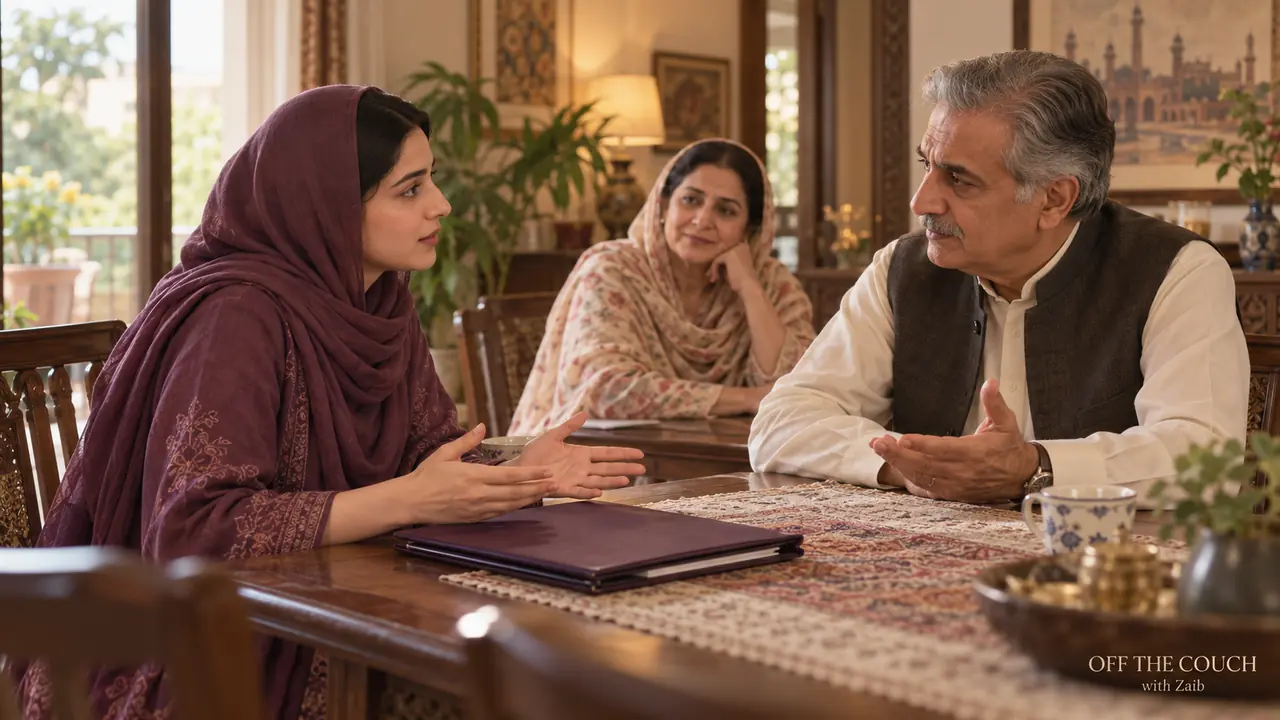
“Hum ne tumhare liye itna kuch kiya hai.”
Sometimes, there is an entire history behind that sentence. School fees paid with difficulty. Extra shifts. Personal needs postponed. Years spent trying to give children a life the parents themselves never had.
That deserves appreciation.
But what does appreciation require afterwards?
Does a grateful daughter have to accept a marriage she doesn’t want? Does a grateful son have to stay in a career that makes him miserable?
A parent may experience disagreement as being pushed aside. Their adult child may feel they are being treated like someone who cannot think. Both start arguing about the decision while feeling hurt about the relationship.
When guidance becomes psychological pressure
Advice becomes harder to consider freely when disagreement repeatedly brings humiliation, threatened withdrawal of affection or responsibility for a parent’s happiness.
In a 2014 Lahore study of 300 adolescents aged 13–17, Rizvi and Najam found associations between reported parental psychological abuse and emotional or behavioural problems. This selected school sample cannot represent every family, and the findings do not establish cause and effect. They do give local evidence that harmful nonphysical treatment deserves attention.
An upset conversation alone does not define a family. The pattern matters.
Can someone explain themselves? Can the parent reconsider? Does an apology ever follow?
There should be room to say, “Main aapki izzat karti hoon, lekin is baat se sehmat nahi hoon,” and still feel secure in the relationship.
Family Roles: Who Becomes Responsible for Everyone?
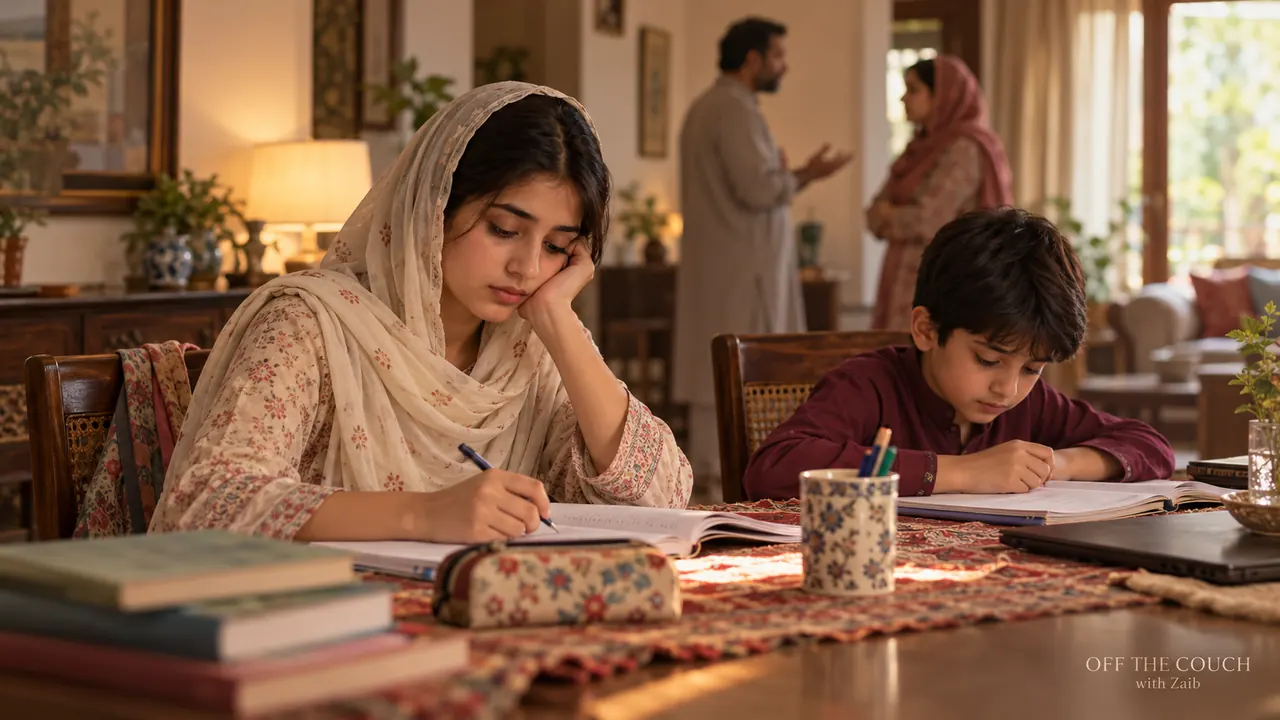
Most families know who will handle things.
The appointment needs booking. Call her. Someone needs money. Ask him. Two relatives aren’t speaking. Let the sensible one sort it out.
Being trusted can feel good, until everyone starts confusing your ability to manage with an unlimited capacity to keep managing.
“Tum samajhdaar ho, tum hi adjust kar lo.”
Perhaps you do. Again.
Nobody asks whether you’re tired because you usually get on with it. Eventually, you may stop mentioning it yourself.
Parentification: when a child carries adult responsibilities
Helping at home can be a healthy part of childhood. Parentification describes a more demanding role reversal, where children carry adult responsibilities beyond what their age and available support allow.
In a 2024 study, Irfan and colleagues interviewed eight adolescents in Lahore experiencing parental discord. Participants described responsibilities involving finances, household management, younger siblings and keeping family relationships together. The researchers also identified emotional costs and suppression of personal needs.
Eight interviews cannot tell us how common this is across Pakistan. They can help us understand what it feels like.
Imagine finishing your homework while listening for signs of another argument. You learn to notice everyone’s mood. People call you mature.
But who notices yours?
A child’s competence should not make their need for care disappear.
Gender Expectations, Marriage and the Pressure to Adjust
A daughter comes home from work and finds guests in the sitting room. She changes and starts helping.
A son comes home from work.
“Thaka hua hai. Pehle araam karne do.”
This won’t describe every home. Where it does, the difference may be so familiar that nobody thinks to explain it.
Boys can receive another set of expectations. Earn well. Become established. Don’t appear weak. Know what you’re doing.
Both can feel pressure, although their freedom and power may be quite different.
Marriage brings these expectations into closer contact. A daughter-in-law joins established household routines. Parents worry about changes in their relationship with their son. A husband avoids difficult conversations, hoping things will settle themselves.
Meanwhile, someone keeps being asked to adjust.
Who changes their routine? Who gives up privacy? Who can disagree without being called difficult?
Calling it a “saas-bahu problem” doesn’t answer much.
Compromise matters. But if one person repeatedly absorbs everyone else’s discomfort, we need to look more closely at what we are asking of them.
Why Pakistani Families Sometimes Struggle to Talk About Feelings
“Khana kha liya?”
Sometimes, that is the most familiar expression of love in the house. Someone saves your dinner, brings fruit or calls because you haven’t said you reached safely.
I wouldn’t dismiss that care because it doesn’t come with a conversation about feelings.
Still, there are things a plate of food cannot help us understand.
You say you’re unhappy.
“Kis cheez ki kami hai tumhein?”
Now you’re explaining that you know you have things to be grateful for. You weren’t denying them. You were describing how you feel.
Parents may struggle with this too. A mother might find it easier to ask about marriage repeatedly than to explain her fears about your future. A father’s worry might come out as irritation.
We cannot assume those explanations fit everyone. We can ask:
“Aapko is baat mein sab se zyada fikr kis cheez ki hai?”
And when someone shares a problem:
“Aap chahte hain main sunoon, ya hum mil kar hal sochein?”
It gives the conversation somewhere to go before advice takes over.
When Family Privacy Protects Harm
“Ghar ki baat ghar mein rehni chahiye.”
Sometimes, I agree. People deserve privacy. An ordinary disagreement doesn’t need to become extended-family entertainment.
But what if keeping something private means the person being hurt has nowhere to turn?
Violence, coercion, threats and repeated humiliation need a different response from disagreements about chores or visiting relatives.
The Pakistan Demographic and Health Survey 2017–18 reported that 34% of ever-married women aged 15–49 had experienced emotional, physical or sexual spousal violence. This figure describes that survey period, rather than a current rate. It shows why harm at home cannot simply be dismissed as a private misunderstanding.
Yet familiar explanations can make it easier to overlook.
“Unka mizaj hi aisa hai.”
“Ghussay mein keh diya hoga.”
After years of hearing this, someone may wonder whether they are making too much of it.
Familiarity does not tell us whether a behaviour is safe. Where speaking up could bring retaliation, confidential professional support and careful planning may be more useful than direct confrontation.
Getting help should not have to count as betraying the family.
How to Set Boundaries in a Pakistani Family
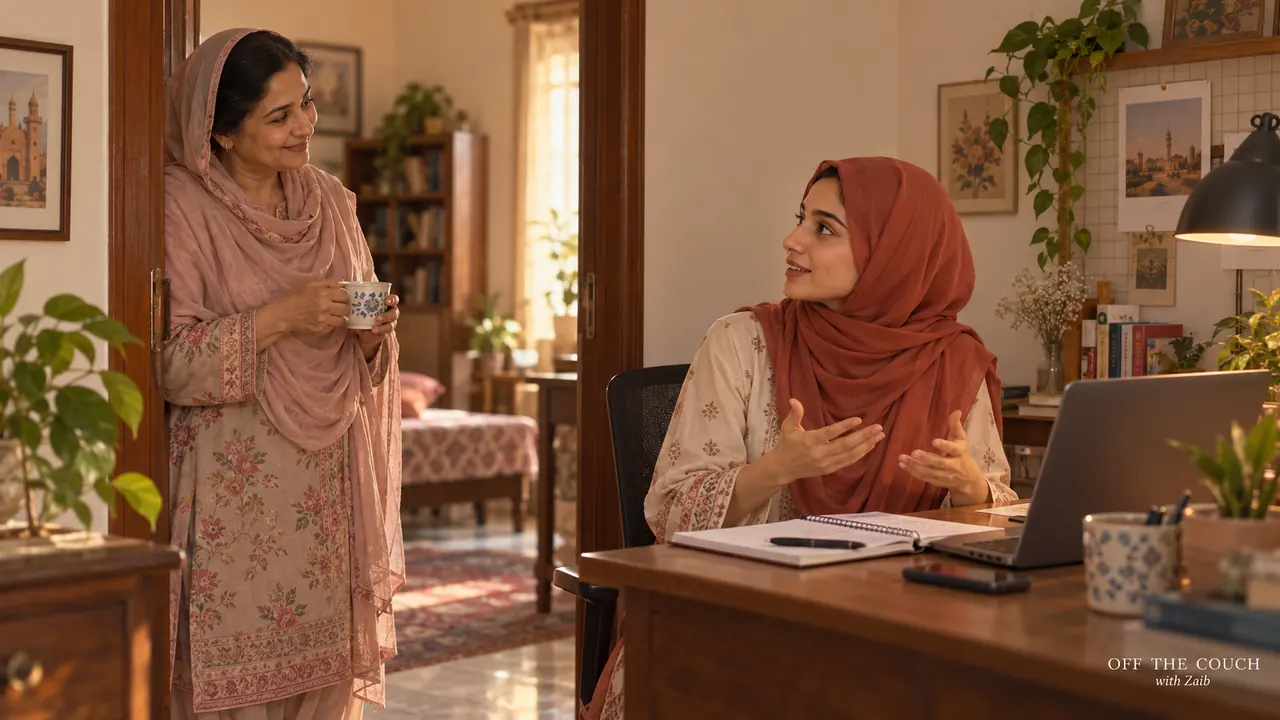
“Just set boundaries.”
It sounds manageable when you’re reading it on your phone. Then you remember that you share a house, depend on financial support or help care for an unwell parent.
You also have to see everyone at breakfast tomorrow.
Begin with a particular situation rather than trying to change every family habit at once.
For repeated marriage questions:
“Jab koi baat final hogi, main khud bata doon gi. Filhaal main is par roz baat nahi karna chahti.”
For carrying messages between arguing relatives:
“Main aap dono ki fikr karti hoon, lekin paighaam pohanchane se baat aur ulajh rahi hai. Aap ek doosray se baat karein.”
For uninterrupted work time:
“Saat se nau mera kaam ka waqt hai. Us ke baad main available hoon.”
Choose a calmer moment. Be specific about what you can offer. Perhaps you can manage one appointment a week, though you cannot manage all of them.
Some disappointment may remain. Clear wording cannot guarantee agreement.
Where changes could put your safety or essential support at risk, build support and options first. A workable boundary has to fit your circumstances.
Can Family Patterns Change Across Generations?
“Hamare saath bhi yahi hua tha.”
What happened? How did it feel? Did it help, or did everyone simply learn to live with it?
Parents raised with harsh discipline may believe it is necessary. Someone whose feelings were routinely dismissed may struggle to understand why their child wants to discuss theirs.
That history can explain the difficulty. It also gives the family something to reconsider.
A 2019 randomised controlled trial involving 110 parents of adolescents in Lahore offers encouragement. Kauser and Pinquart tested a seven-session programme promoting authoritative parenting, which combines warmth with clear expectations. Participating parents showed improvements in parenting practices and reported reductions in their children’s challenging behaviour.
The findings concern a selected group, but suggest that different responses can be learned.
At home, change may begin with allowing an explanation before passing judgement. Or saying:
“Mujhe tum se is tarah baat nahi karni chahiye thi.”
Then comes the next disagreement. Another opportunity to pause, listen and respond differently.
That is where the apology starts becoming believable.
A Family Where Closeness Leaves Room to Breathe

I don’t think most people want to stop caring about their families.
They want the familiar voices, the shared jokes, the person who remembers what they liked as a child. They want to know somebody will come when things go wrong.
They may also want privacy, a fairer share of responsibilities and the chance to make a choice without questioning their place in the family afterwards.
Those wishes can belong together.
If recurring family conflict is affecting your wellbeing, a psychological consultation can help you understand the pattern and consider realistic next steps.
You can appreciate what your family has given you and still ask for something you need.
Sometimes, that request is simple:
“Meri baat bhi sun lein.”
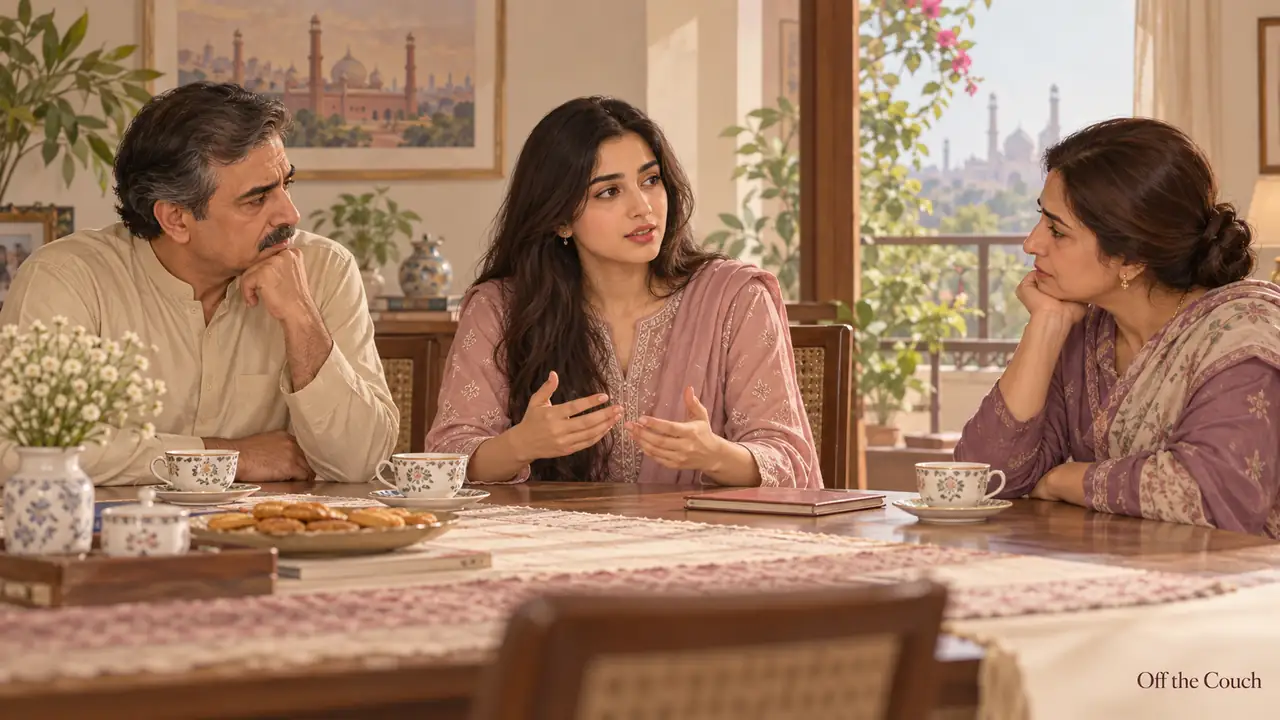
What do we do when someone says that?
Do we become so busy explaining our intentions that we miss what they are telling us? Do we remind them of everything we have done for them? Or can we stay with their experience long enough to understand it?
We may be the person wishing to be heard in one relationship and the person struggling to listen in another.
That is worth noticing.
Our families will not agree on everything. There will still be worries, differences and conversations that take more than one attempt. But perhaps we can make those conversations easier to have.
So that someone can tell us what hurts before deciding there is no point explaining. So that asking for space does not put their belonging in question.
And so that, when someone says, “Meri baat bhi sun lein,” we can make room for an answer as ordinary as:
“Haan, batao. Main sun rahi hoon.”
Sources & further reading
- Lodhi and colleagues (2021). Factors associated with quality of life among joint and nuclear families: a population-based study. BMC Public Health.
- Rizvi and Najam (2014). Parental psychological abuse toward children and mental health problems in adolescence. Pakistan Journal of Medical Sciences.
- Irfan and colleagues (2024). Parenting the parents: A phenomenological study of parentified adolescents in Pakistan. Journal of Community & Applied Social Psychology.
- National Institute of Population Studies and ICF. Pakistan Demographic and Health Survey 2017–18: Summary Report.
- Kauser and Pinquart (2019). Effectiveness of an indigenous parent training program on change in parenting styles and delinquent tendencies (challenging behaviors) in Pakistan: A randomized controlled trial. Journal of Experimental Child Psychology.

3 responses