Why understanding someone’s feelings doesn’t always mean treating them well, and why kindness sometimes requires more than good intentions.
There is something I find interesting about the way we describe people.
Someone is called a good person because they are polite. Someone else is considered kind because they help everyone around them. And when a person becomes emotional while listening to another person’s problems, we often say, “They’re very empathetic.”
But I’ve noticed that these qualities don’t always appear together.
A person can be wonderfully polite to strangers and unnecessarily harsh with their own family. Someone can understand exactly why another person is upset and still choose to dismiss their feelings. And sometimes, the person who doesn’t say much or show a great deal of emotion is the one who quietly makes sure everyone is okay.
It makes me wonder how often we confuse appearing kind with actually being kind.
We talk about empathy as though it automatically makes us better people. We encourage children to be kind, remind adults to understand one another, and share messages about compassion whenever something unfortunate happens.
Yet we still struggle with some of the simplest things.
Listening without interrupting. Disagreeing without humiliating someone. Recognising that another person’s circumstances may be different from ours. Apologising without immediately explaining why we behaved the way we did.
Perhaps the interesting question isn’t whether people know that kindness matters.
Most of us already do.
The question is why knowing it doesn’t always change how we treat one another.
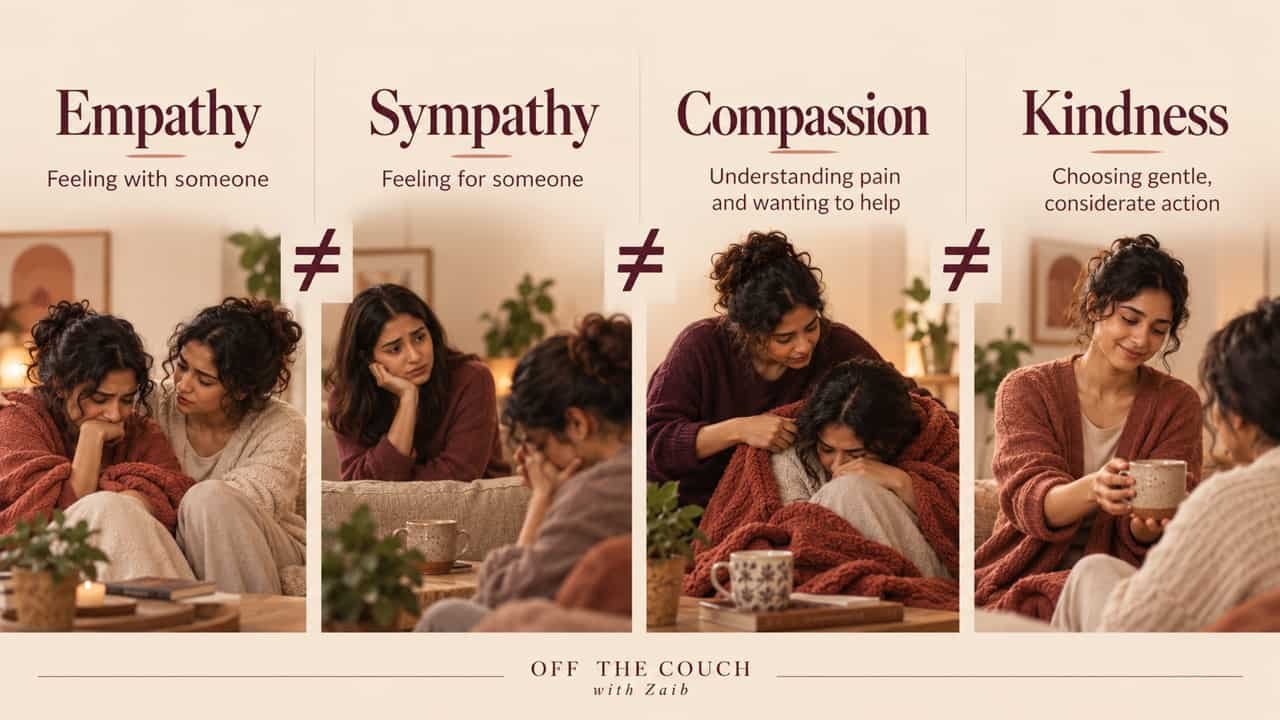
Empathy vs. Sympathy, Compassion, and Kindness
Before discussing why people behave the way they do, I think it’s worth separating a few concepts we regularly use interchangeably.
Empathy involves understanding or sharing something of another person’s emotional experience.
Psychologists often distinguish between cognitive empathy and affective empathy.
Cognitive empathy is our ability to recognise or understand what another person might be thinking or feeling. Affective empathy refers to our emotional response to someone else’s experience, although researchers differ in how they define its components.
Imagine a colleague who has recently lost someone close to them.
You might understand that they’re finding it difficult to concentrate, even if you haven’t experienced a similar loss yourself. That’s an example of cognitive empathy.
You might also feel sadness when you see how distressed they are. That involves an affective response.
Sympathy is generally about feeling concern or sorrow for someone’s suffering. It doesn’t necessarily require experiencing their feelings alongside them.
Compassion goes a little further. It involves recognising suffering and being concerned about alleviating it.
And kindness is expressed through how we behave. It might involve offering help, speaking respectfully, making room for someone’s difficulties, or choosing not to make an already painful situation worse.
These distinctions matter because understanding someone’s emotions does not guarantee that we’ll respond helpfully.
A person might recognise another’s insecurity and use it against them during an argument.
Someone else might struggle to understand exactly what another person is feeling but still behave with patience and consideration.
So when we say, “This person has no empathy,” we may sometimes be describing something more specific: a lack of concern, an unkind response, or an unwillingness to consider another perspective.
Those aren’t necessarily identical psychological problems.
Why Empathy Doesn’t Always Prevent Hurt
Think about an argument between two people who know each other extremely well.
They know each other’s history, fears, sensitivities, and insecurities.
You might expect that this understanding would make their disagreements gentler.
Sometimes it does.
But sometimes, that knowledge becomes part of the argument.
A person knows exactly which comment will hurt their partner. A sibling knows which insecurity has followed their brother or sister since childhood. A friend knows what someone is already struggling with and still makes a joke about it in front of others.
This is one reason I hesitate when empathy is presented as a complete explanation for moral behaviour.
Understanding another person’s emotional world is an ability. What we choose to do with that understanding is another matter.
Our responses are also influenced by anger, resentment, perceived threats, personal values, social norms, and the consequences we expect from our actions.
A person might be capable of understanding another’s pain but become so focused on winning an argument that this understanding stops guiding their behaviour.
Or they may convince themselves that their harshness is justified.
“Usne mere saath bhi toh aisa kiya tha.”
“Isko isi tarah samajh aati hai.”
“Main ghalat nahi keh raha, sach hi toh bol raha hoon.”
Notice how these explanations shift attention away from the effect of the behaviour.
The person may still understand that their words are hurtful. They simply believe they have a sufficient reason to say them.
This doesn’t mean empathy is unimportant.
It means empathy needs to work alongside emotional regulation, responsibility, and concern for others if it is to influence behaviour consistently.
Why We’re Kinder to Strangers Than Family

Have you ever noticed how differently someone can speak depending on who is listening?
At work, they may be patient, accommodating, and careful with their words.
With guests, they’re attentive and welcoming.
But at home, the smallest inconvenience brings irritation.
A misplaced object. A delayed meal. Someone asking a question at the wrong moment.
Suddenly, the patience they seemed to have throughout the day disappears.
It’s tempting to conclude that the kindness shown outside the home was entirely fake. But human behaviour is usually more complicated than that.
Different environments create different expectations.
In professional and public settings, people often monitor how they present themselves. There are reputational consequences for being rude, and social norms encourage certain forms of politeness.
At home, people may feel less pressure to manage every expression of frustration.
Familiarity can create emotional safety, but it can also lead people to take one another’s patience for granted.
Stress and exhaustion may contribute as well. Someone who has spent the day regulating their reactions might find it harder to respond thoughtfully later, although this is not inevitable and does not excuse mistreatment.
In Pakistani households, another factor sometimes enters the picture: hierarchy.
Respect is frequently discussed in terms of age, status, and relationships.
“Baron se tameez se baat karo.”
It’s a valuable lesson to teach children to speak respectfully.
But I think we need to ask whether the same expectation applies in the opposite direction.
Can an adult humiliate a child and still consider themselves respectful because the child is younger?
Can a senior family member dismiss someone’s feelings simply because they have more authority?
If respect only travels upwards, it becomes difficult to distinguish it from obedience.
A person’s age or position may influence the responsibilities they hold, but it doesn’t make another person’s dignity less important.
And perhaps kindness is tested most meaningfully in relationships where we have enough power to behave otherwise.
Why We Judge Others Too Quickly
Imagine a woman who rarely attends family gatherings.
Relatives begin describing her as arrogant.
“Bohat attitude hai.”
“Kisi se milna julna pasand nahi.”
“Apne aap ko pata nahi kya samajhti hai.”
But perhaps she is caring for someone at home. Perhaps she’s struggling financially. Perhaps gatherings have become emotionally exhausting because people repeatedly question her personal decisions.
Or perhaps she simply prefers spending less time in large groups.
We don’t know.
Yet it’s surprisingly easy to turn a small observation into a conclusion about someone’s character.
Social psychologists have long studied how people explain behaviour. One relevant concept is the fundamental attribution error, which describes a tendency, particularly demonstrated in certain research settings, to place too much emphasis on personal characteristics and too little on situational influences when explaining other people’s actions.
In everyday language, we sometimes interpret what someone does as evidence of who they are, without sufficiently considering what might be happening around them.
Someone responds late to a message, so we assume they don’t care. Similar assumptions can turn everyday interactions into conflict, as explored in why small misunderstandings turn into big arguments.
A colleague makes a mistake, so we call them irresponsible.
A person appears quiet, so we decide they’re unfriendly.
Of course, circumstances don’t explain away every harmful action. Sometimes behaviour really does reflect a person’s choices or recurring patterns.
But before deciding what kind of person someone is, it’s worth considering how much information we actually have.
I think this is where empathy becomes particularly useful.
It encourages us to consider possibilities beyond our first interpretation.
Not because every explanation must be accepted, but because our first explanation isn’t necessarily the most accurate one.
Selective Empathy: Who Gets Our Understanding?
We often think of empathy as a stable personality quality.
Either someone has it or they don’t.
But our empathic responses can change depending on who is involved, how we perceive them, and what we believe they deserve.
It’s generally easier to feel concern for someone we identify with. We may recognise our own struggles in their experiences, understand their background, or feel emotionally connected to them.
When someone’s circumstances are unfamiliar, understanding may require more deliberate effort.
Consider how people sometimes react when a young woman discusses pressure from her family.
Someone who has experienced similar restrictions may immediately understand her distress.
Another person might say, “Parents hamesha bachon ki bhalai chahte hain. Itna issue banane ki kya zaroorat hai?”
Both may believe they’re being reasonable.
But one is considering the woman’s experience, while the other is primarily interpreting the situation through their own beliefs about family.
This doesn’t necessarily mean the second person lacks empathy altogether. They may be highly understanding in other situations.
Research by Jean Decety and Jason Cowell has explored why empathy and moral behaviour have a more complicated relationship than we sometimes assume. Different components of empathy can influence how people make moral judgements, and empathic concern does not always operate impartially.
I think this matters when we discuss kindness.
We shouldn’t have to identify with someone’s circumstances before deciding that they deserve respectful treatment.
You don’t have to understand why a person wants a different career, marriage, lifestyle, or relationship with their family to acknowledge that their choices deserve consideration.
Sometimes, kindness begins with recognising the limits of our own understanding.
Kindness Without People-Pleasing
One of the most common misunderstandings about kindness is that it requires constant accommodation.
A kind person is expected to say yes.
To forgive quickly.
To remain available.
To understand everyone else’s circumstances, even when nobody seems interested in understanding theirs.
And when that person finally expresses frustration or sets a boundary, people may respond as though their character has suddenly changed.
“Tum pehle toh aisi nahi thi.”
“Ab tumhein kya ho gaya hai?”
“Itna sa kaam bhi nahi kar sakti?”
But kindness and compliance are not the same thing. The same tension between care and personal choice appears in our discussion of social approval and the fear of what people will say.
You can understand that a friend is struggling financially without repeatedly lending money you cannot afford to lose.
You can recognise that a family member is upset without accepting insults during every disagreement.
You can care about someone’s disappointment and still make a decision they don’t like.
In fact, some of the most respectful conversations involve disagreement.
A person who says, “I understand why you’re upset, but I don’t agree with what you did,” may be demonstrating more genuine consideration than someone who agrees simply to avoid an uncomfortable conversation.
Kindness doesn’t require us to abandon our judgement.
And empathy doesn’t require us to take responsibility for every emotion another person experiences.
This distinction is particularly important in relationships where one person is routinely expected to be understanding while the other faces very few expectations.
A relationship becomes difficult to sustain when one person’s empathy is treated as an unlimited resource and the other’s behaviour is rarely questioned.
Empathy Fatigue and Emotional Exhaustion
People sometimes describe themselves as exhausted because they care too much.
They absorb other people’s problems, worry about everyone’s feelings, and feel guilty whenever they cannot help.
You may have heard someone say, “I’m tired of being the person everyone comes to.”
There is a meaningful psychological distinction here.
Understanding someone’s distress, feeling overwhelmed by their distress, and responding compassionately are not identical experiences.
When another person’s suffering produces intense personal distress, our attention can shift towards managing our own discomfort.
Compassion, by contrast, involves concern for the other person without necessarily becoming overwhelmed by the same emotions.
A 2026 systematic review and meta-analysis examined 79 samples involving 20,595 participants. It found that cognitive empathy and compassion were associated with lower burnout symptoms, while emotional contagion was associated with higher burnout symptoms. These are associations, not proof that one response directly causes or prevents burnout.
The findings are especially relevant when we casually suggest that empathy itself is emotionally damaging.
It isn’t that simple.
Research on compassion fatigue has also questioned whether the term adequately captures the occupational stress experienced by healthcare professionals. Working conditions, resources, and cumulative stress deserve attention rather than assuming that compassionate people inevitably suffer because they care.
For everyday relationships, I think the practical lesson is straightforward.
You can listen to someone without becoming responsible for solving their entire life.
You can support a friend while recognising that you have limitations of your own.
And you can be compassionate without being constantly available.
Sometimes, the kindest response is to acknowledge what you can realistically offer.
“Main tumhari baat samajh rahi hoon, lekin abhi mere paas itni emotional capacity nahi hai. Hum kal baat kar sakte hain?”
That isn’t necessarily rejection.
It may be an honest attempt to preserve a relationship without allowing resentment and exhaustion to build.
Why Good Intentions Aren’t Enough
There’s a familiar sentence we hear after someone has been hurt.
“Mera woh matlab nahi tha.”
I didn’t mean it that way.
And sometimes, that’s completely true.
A person may genuinely intend to help but say something insensitive. They may offer advice when someone needs to be heard. They may make a joke without realising it touches on a painful experience.
Intentions matter because they help us understand why someone behaved as they did.
But they don’t erase the effect of the behaviour.
Imagine telling someone who has been struggling with infertility:
“Abhi tak koi good news nahi?”
The person asking may simply be curious. They may even believe they’re expressing affection or concern.
But repeated questions about something deeply personal can become painful, especially when the individual is already experiencing medical difficulties or family pressure.
A more considerate approach would be to recognise that not every subject is appropriate for casual conversation.
Similarly, telling someone with anxiety to stop worrying may come from a genuine desire to reassure them.
But reassurance that dismisses the person’s experience may leave them feeling less understood.
The solution isn’t to become afraid of every word we say.
It’s to remain willing to reconsider our approach when someone tells us it has hurt them.
Instead of immediately defending our intentions, we can ask:
“Did I misunderstand what you needed?”
“Would you rather I listen instead of offering advice?”
“I didn’t realise that question was uncomfortable. I’m sorry.”
These are small adjustments, but they change the nature of an interaction.
They communicate that the other person’s experience matters, even when it differs from what we intended.
Everyday Kindness Beyond Public Gestures
I sometimes think our understanding of kindness has become too closely connected to visible gestures.
We notice the person who makes a generous donation, offers a public compliment, or shares an emotional message about helping others.
These actions can be meaningful.
But some of the most important expressions of kindness are much less noticeable.
It’s the supervisor who corrects an employee privately rather than embarrassing them in front of colleagues.
The family member who doesn’t turn someone’s personal difficulty into a topic of discussion.
The friend who respects a refusal without demanding an explanation.
The person who treats a waiter, cleaner, security guard, or domestic worker with the same basic courtesy they extend to someone influential.
These situations interest me because they reveal something about the relationship between kindness and power.
It’s relatively easy to behave respectfully when the other person has the authority to challenge us.
The more revealing question is how we behave when they don’t.
Do we still consider their dignity?
Do we recognise their time and effort?
Do we apologise when we’ve been unfair?
In many Pakistani settings, social position shapes how people are addressed and treated. Titles, age, family relationships, and professional status can carry considerable weight.
Respecting these relationships isn’t inherently problematic.
The difficulty begins when status becomes a reason to overlook someone else’s humanity.
A domestic worker shouldn’t need an impressive designation to deserve courtesy.
A child shouldn’t need to become an adult before their feelings are taken seriously.
And someone who depends on us financially or emotionally shouldn’t have to accept humiliation as part of that dependence.
Kindness matters most when it isn’t conditional on what someone can do for us.
How to Teach Kindness That Lasts

Children are frequently reminded to be good.
Share your things.
Respect your elders.
Don’t argue.
Help people.
These lessons can encourage cooperation and consideration, but I wonder whether we sometimes focus more on outward obedience than on the reasoning behind respectful behaviour.
A child who is told not to argue may learn to remain silent even when something feels unfair.
A child who is forced to apologise may learn the words without understanding what happened.
And a child who repeatedly watches adults ridicule others may absorb that behaviour despite being instructed to speak politely.
Children learn from what adults explain, but they also learn from what adults demonstrate.
If we want them to consider other people’s feelings, we can help them think about the effects of their actions.
If we want them to apologise sincerely, we can show them what taking responsibility looks like.
And if we want them to understand respect, we should allow them to experience it themselves.
That doesn’t mean removing discipline, expectations, or appropriate boundaries.
It means recognising that teaching kindness involves more than demanding agreeable behaviour.
Adults need these lessons too.
We may know how to speak politely and still struggle to manage anger.
We may value compassion but become dismissive when someone challenges our beliefs.
We may expect understanding from our partners, colleagues, and families while offering very little in return.
Developing empathy is not a matter of memorising a few reassuring sentences.
It requires curiosity, self-awareness, and a willingness to recognise when our interpretation of another person might be incomplete.
The Real Test of Kindness
I don’t think kindness means being gentle every moment of the day.
People become tired, frustrated, impatient, and overwhelmed. Even individuals who care deeply about others sometimes respond poorly.
One unpleasant interaction doesn’t tell us everything about someone’s character.
But repeated behaviour matters, particularly when a person knows they’re causing harm and makes little effort to change.
That’s why I find it more useful to think of kindness as something we practise rather than something we simply possess.
It appears in the moment when we’re irritated but choose not to humiliate someone.
When we recognise that a person has disappointed us without deciding that they deserve cruelty.
When we listen to an explanation that challenges our assumptions.
When we apologise because we’ve been unfair, not merely because we want an argument to end.
And when we accept that another person can have feelings, needs, and boundaries that don’t revolve around our expectations.
We won’t always understand people correctly.
We won’t always agree with their decisions.
And we certainly won’t always know what they’re going through.
But perhaps we don’t need complete understanding to begin treating someone with consideration.
Empathy can help us understand another person’s experience. Compassion can motivate us to respond to their suffering. Kindness is reflected in what we actually do.
The distinction is worth remembering.
Because in the end, people don’t experience our intentions directly.
They experience our words, our decisions, and the way we treat them.
And that is where our values become visible.
Research references
- Decety, J., & Cowell, J. M. (2014). Friends or Foes: Is Empathy Necessary for Moral Behavior? Perspectives on Psychological Science.
- Decety, J., & Cowell, J. M. (2014). The Complex Relation Between Morality and Empathy. Trends in Cognitive Sciences.
- Martingano, A. J., Stosic, M. D., & Konrath, S. (2026). Different Empathy Types Show Opposing Associations With Burnout: Systematic Review and Meta-Analyses. Psychology, Health & Medicine.
- Sinclair, S., et al. (2017). Compassion Fatigue: A Meta-Narrative Review of the Healthcare Literature. International Journal of Nursing Studies.